

Trade show floors are built to overwhelm people. Every aisle has another screen, banner, product demo, sales rep, bowl of candy, blinking display, or branded giveaway competing for the same few seconds of attention. A company can spend heavily on booth space and still become part of the background before the first morning is over.
A strong booth doesn’t need to be the biggest installation in the hall. It needs to communicate quickly, look intentional, give people a comfortable reason to stop, and make the next interaction easy. The companies that get the most from events usually think beyond booth decoration and treat the entire space as a coordinated marketing experience.
Good trade show booth ideas start with that bigger picture. Signage, staff, printed materials, promotional products, lead capture, and follow-up all need to support the same goal. When those pieces work together, a small footprint can outperform a much larger booth filled with disconnected elements.
Give People A Reason To Stop
Attendees rarely approach a booth because they want to hear a sales pitch. They stop because something catches their eye, answers a question, offers an experience, or gives them an immediate reason to spend another thirty seconds in the space.
Start with one clear message. Not the company history. Not six services. Not a paragraph pulled from the website homepage. The booth needs to tell passing attendees what the company does or why they should care almost immediately.
A cybersecurity company might lead with a specific business problem rather than a broad statement about innovative technology. A food brand might lead with a live tasting. A software provider might let visitors test a workflow on a screen. A production company may use a striking reel that makes sense even with the sound off.
Strong hooks can include:
- A product demonstration that takes less than two minutes.
- A clear question connected to a common customer problem.
- An interactive display or physical product people can touch.
- A useful giveaway tied to a quick conversation.
- A visual installation people naturally want to photograph.
- A short consultation or assessment offered at the booth.
The goal isn’t to stop everyone. A booth works better when it attracts the people who are actually relevant to the business.
That focus also makes the space easier to design. Once the team knows who should stop and what should make them stop, nearly every other decision becomes easier.
Design For The Three-Second Decision
Most attendees first see a booth as they walk. They may be twenty feet away, carrying a bag, talking with a colleague, checking their phones, or looking for another exhibitor.
That isn’t the environment for complicated messaging.
Primary signage should be readable from the aisle and understandable without explanation. Small type, long sentences, multiple competing headlines, and vague marketing language force attendees to work too hard. Most won’t.
The visual hierarchy usually needs three levels.
First is the main message. This should be the biggest and easiest element to read. It tells people what the booth is about.
Second is supporting context. This could be a product category, benefit, short description, or visual demonstration that helps the right attendee understand the offer.
Third is the detail. Brochures, sales sheets, QR codes, product specifications, case studies, and deeper information belong here.
The booth itself needs breathing room too. Filling every available wall, counter, and tabletop can make even expensive materials look cheap. Empty space helps important elements stand out.
Sight lines deserve attention before anything goes to production. A banner that looks great on a computer screen may end up hidden behind staff members. A headline positioned too low can disappear as soon as five people gather around the booth.
Good design assumes people will stand in front of it.
Treat Giveaways As Marketing Tools, Not Table Filler
Promotional items can extend the life of a trade show interaction far beyond the event, but only if attendees actually want the item.
Cheap giveaways create a familiar cycle. Someone picks up the item because it’s free, carries it around for a few hours, and throws it away while packing for the flight home. The company paid for an impression that lasted less than a day.
Useful items operate differently. They make their way into offices, cars, backpacks, kitchens, production bags, and daily routines. Every additional use keeps the brand visible without requiring another advertising purchase.
That’s why product selection should start with the audience, not the catalog.
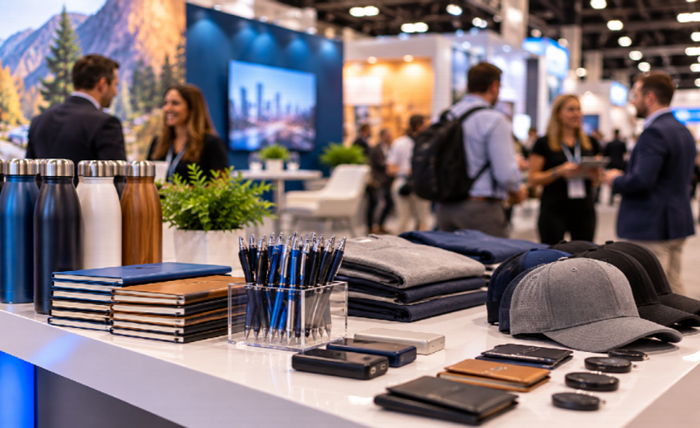
A technology conference may be a good fit for charging accessories, cable organizers, phone accessories, or desk products. A creative-industry event might support better apparel, reusable bags, notebooks, or collectible items. Premium gifts can make sense for scheduled meetings or qualified prospects while lower-cost pieces handle general booth traffic.
Businesses evaluating options can look at MM Hollywood’s breakdown of the best promotional products for trade shows in 2026 for examples across apparel, drinkware, technology accessories, sustainable products, and higher-end event gifts.
Consider branding as carefully as the item itself. A good product can become less desirable when a logo covers half of it.
Smaller, cleaner branding often makes an item more appealing for public use. Embroidery, engraving, subtle screen printing, and thoughtful packaging can also make a relatively simple product feel far more considered.
Giveaways work best when they earn their way into someone’s routine.
Make Every Printed Piece Earn Its Space
Trade shows generate enormous amounts of paper. Brochures, postcards, sell sheets, catalogs, business cards, schedules, folders, and promotional flyers appear on nearly every table.
Much of it never makes it home.
That doesn’t mean print is ineffective. It means generic print is easy to abandon.
A booth handout should have a clear purpose. One piece might explain the primary service. Another could provide technical specifications needed for a buying decision. A compact postcard may be enough when the goal is to get someone to a landing page or book a call.
Materials can be divided into levels based on the interaction:
- Quick handouts for people who want basic information.
- Product or service sheets for visitors asking specific questions.
- Case studies for qualified prospects evaluating results.
- Premium folders or presentation materials for scheduled meetings.
- Business cards for personal contact information and direct follow-up.
QR codes can reduce the amount of paper needed, but they shouldn’t automatically replace every physical piece. A well-produced card or brochure can stay on someone’s desk after the badge, tote bag, and event schedule have disappeared.
Print works best when it gives the attendee something worth keeping.
Build The Booth Around Conversation
A trade show booth can look incredible and still underperform if the people working it spend the day staring at their phones.
Staffing is part of the booth design.
The team needs room to talk without blocking the entrance. Counters shouldn’t form a physical barricade between staff and attendees unless the booth is intentionally built around demonstrations. Chairs positioned too prominently can encourage staff members to sit behind tables rather than interact with the aisle.
Plan conversation starters before the show.
“What does your company do?” is rarely the strongest opening. Neither is launching directly into a product pitch.
Simple questions tied to the event and audience usually work better:
- What brought the attendee to the show?
- What kind of solution are they currently using?
- What problem are they trying to solve?
- Which sessions or exhibitors have interested them?
- Is the company planning a project in the next six to twelve months?
The objective is to find common ground quickly.
Staff members also need an easy way to exit conversations that aren’t relevant. Every ten-minute discussion with someone who will never become a customer can mean missing several stronger opportunities walking past the booth.
Good booth staff is friendly without becoming passive and informed without delivering memorized speeches.
Make Lead Capture Part Of The Experience
A stack of scanned badges isn’t automatically a list of leads.
One of the most common trade show problems happens after the event, when the sales and marketing teams have hundreds of names but almost no context about who those people are or what they discussed.
Lead capture should preserve the conversation.
If a badge scanner or event app allows notes, the staff member can record a few useful details immediately:
- What the attendee asked about.
- The product or service that interested them.
- Their expected timeline.
- Whether they requested pricing or a demonstration.
- Who should follow up.
- Any personal detail that helps reconnect the conversation later.
Forms should stay short enough that staff members will actually complete them.
Some companies also create different follow-up paths based on booth activity. Someone who attended a scheduled product demonstration may receive different information from someone who scanned a QR code and picked up a brochure.
The trade show interaction should make the next step obvious. That might be booking a meeting, requesting a quote, starting a trial, viewing a technical resource, or simply connecting with the right person after the event.
Plan Logistics Like A Live Production
The most polished booth in the hall can become a problem quickly if the banners arrive late, the wrong files go to print, electrical access wasn’t ordered, or half the promotional products are sitting in a warehouse across town.
Trade shows run on deadlines.
A practical production schedule should work backward from the date the team needs everything physically available. That date is often earlier than the first day of the show.
The plan may need to account for:
- Artwork approval.
- Printing and production.
- Promotional product decoration.
- Freight or local delivery.
- Venue receiving deadlines.
- Booth installation windows.
- Electrical and internet orders.
- Staff travel.
- Replacement or emergency materials.
Artwork deserves its own review. Low-resolution logos and poorly prepared files become painfully obvious when enlarged onto banners, table covers, wall graphics, or signage.
Physical samples can also prevent expensive surprises when ordering higher-value merchandise. Colors, fabric weight, imprint size, packaging, and material quality may look different in person than they do in a product catalog.
Last-minute changes are sometimes unavoidable. Building extra time into production makes those changes manageable, not catastrophic.
Keep The Campaign Going After The Floor Closes
A trade show doesn’t end when the booth comes down.
The next few days often determine whether the event produced meaningful business or simply generated a collection of business cards.
Follow-up should connect directly to the conversation that happened at the booth. Generic “Thanks for visiting us” emails are easy to ignore because they sound exactly like the emails every other exhibitor sends.
Specific follow-up performs a different job.
If someone asked about pricing, send the pricing information. If they wanted a technical specification, send it. If the conversation involved a particular project, reference that project. If they requested a meeting, make scheduling the main call to action.
Speed helps too. A prospect may have spoken with dozens of companies at the event. Waiting two weeks increases the chance that the conversation will blur into the rest of the show.
Marketing teams can also extend event content through social posts, photography, recap articles, product demonstrations, and short videos created while the booth is active.
A three-day event can support weeks of marketing when content capture is part of the plan.
Frequently Asked Questions About Trade Show Booth Planning
How Far In Advance Should A Business Plan A Trade Show Booth?
Planning should begin several months before larger events, especially if the booth requires custom graphics, promotional merchandise, freight, furniture, electrical service, or complex displays. Smaller tabletop exhibits may need less lead time, but artwork and production deadlines can arrive sooner than expected. Working backward from the show’s receiving and installation dates helps keep everything organized. Extra time also provides room for proofing, revisions, and shipping delays.
What Should Be Included In A Trade Show Booth?
Most booths need clear signage, a primary message, supporting visuals, printed or digital information, lead capture, and a defined space for conversations. Products or demonstrations should be easy to see without making the booth difficult to enter. Promotional items can support the experience if they serve a clear purpose. Every element should help attract, inform, or convert the right attendees.
Are Trade Show Giveaways Still Effective?
They can be extremely effective when the item is useful and appropriate for the audience. Promotional products lose value when you choose them only because they are inexpensive or available in large quantities. Products that attendees continue using create repeated brand exposure after the event. Consider quality, usefulness, branding, and distribution strategy before ordering.
How Much Branding Should Go On Promotional Merchandise?
Branding needs to be visible without making the product undesirable. A smaller embroidered logo on a quality hat or a subtle engraved mark on drinkware may have more long-term value than oversized branding across every surface. The product still needs to look like something the recipient would choose to use. Decoration methods should also fit the material and expected lifespan of the item.
Should Every Trade Show Visitor Receive A Giveaway?
Not necessarily. Some booths use inexpensive items for general traffic and reserve premium merchandise for qualified prospects, scheduled meetings, customers, or press contacts. That approach can control costs while making better items feel more valuable. Staff should understand the distribution plan before the doors open so merchandise doesn’t run out during the first few hours.
What Makes Trade Show Signage Effective?
Effective signage communicates its main idea quickly and remains readable from the aisle. Strong contrast, large type, concise copy, and a clear visual hierarchy are more useful than trying to place every service on the wall. Important messaging should also remain visible when people are standing inside the booth. Testing layouts at full scale can reveal problems that aren’t obvious on a laptop.
How Should Businesses Capture Leads At Trade Shows?
Lead capture should collect enough information to support meaningful follow-up without slowing down booth interactions. Badge scanning, event apps, QR forms, and simple digital forms can all work. The most useful systems let staff add notes about the conversation. Context makes the lead far more valuable after the event.
How Quickly Should A Company Follow Up After A Trade Show?
Priority prospects should generally receive follow-up while the event is still fresh. Waiting too long gives attendees time to forget individual conversations, especially after a large conference. Messages should reference what was discussed instead of relying on a generic event email. Different lead types may also need different messages and next steps.
A Better Booth Starts Before Anyone Walks Through The Door
Trade show performance isn’t determined by booth size alone. A clear idea executed well can create more meaningful conversations than a huge space filled with competing messages.
The strongest booths make every piece work together. Signage attracts attention. Staff create the conversation. Printed materials support it. Promotional products extend it. Lead capture preserves it. Follow-up moves it forward.
That level of coordination begins long before attendees enter the hall. When the planning is thoughtful, the booth stops being rented floor space and starts doing the job it was paid to do.


